Lesson 1 · AI Around Us
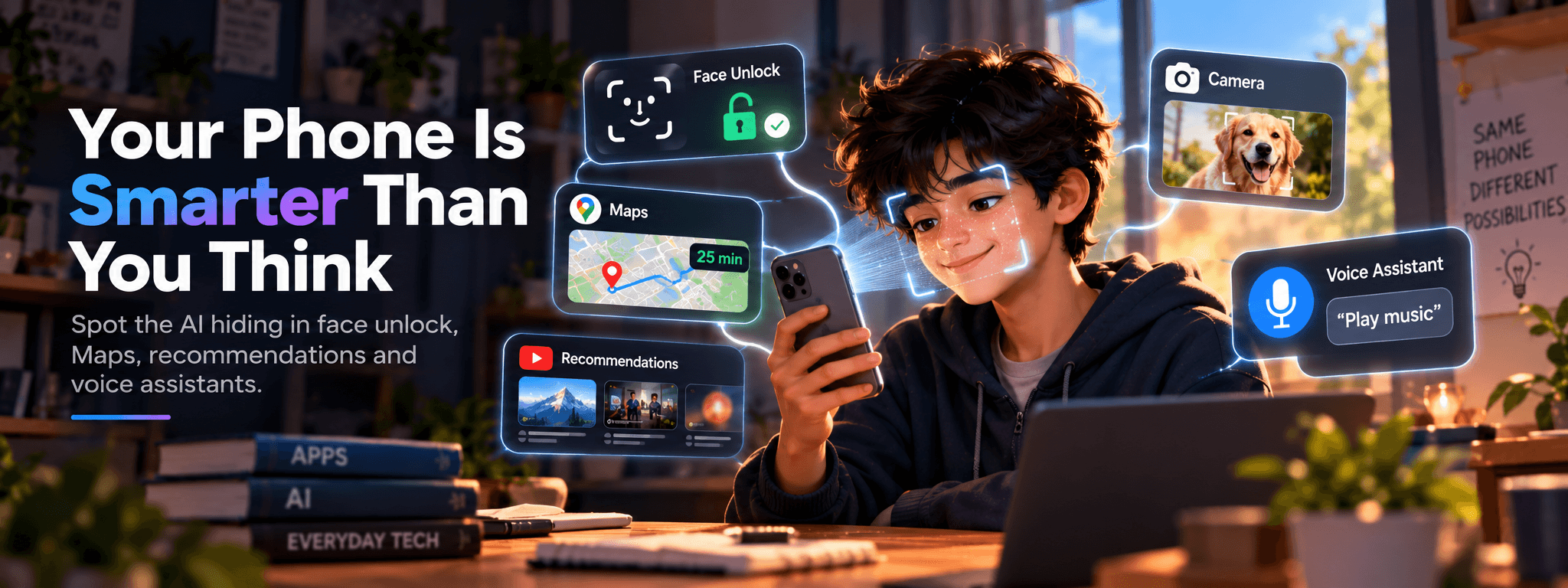
Your Phone Is Smarter Than You Think
Spot the AI hiding in face unlock, Maps, recommendations and voice assistants.
Easy~12 minFree chapter
Welcome to the World of AI
Some tools learn from examples; others follow fixed rules. Compare a photo sorter with a school bell timer. If you cannot tell how a tool works, say you need more information.
 Click to zoom
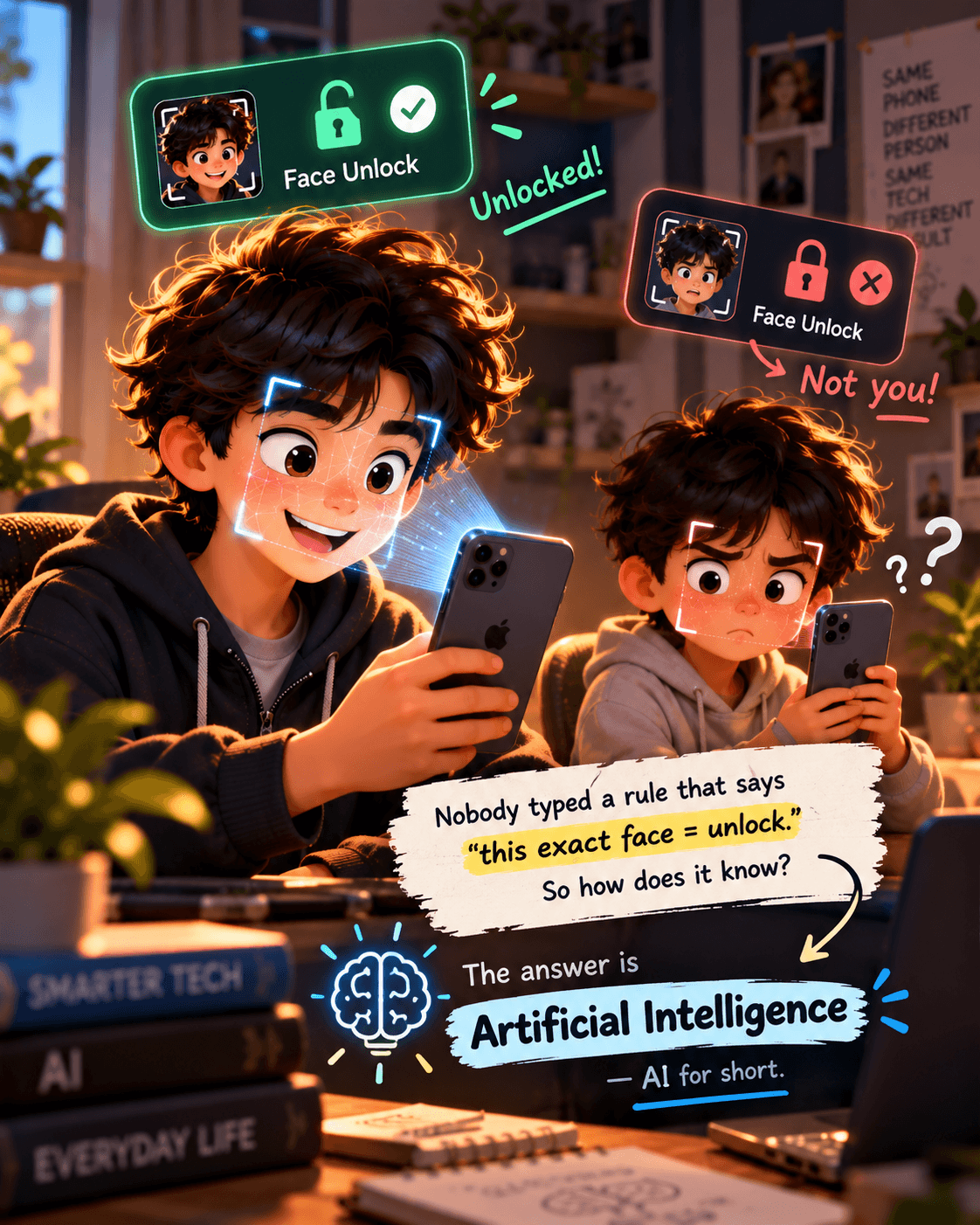
You lift your phone and — click — it unlocks the moment it sees your face. Your little brother tries the same phone and it stays locked. 🤔
Nobody typed in a rule that says "this exact face = unlock." So how does it know? The answer is Artificial Intelligence — AI for short.
 Click to zoom
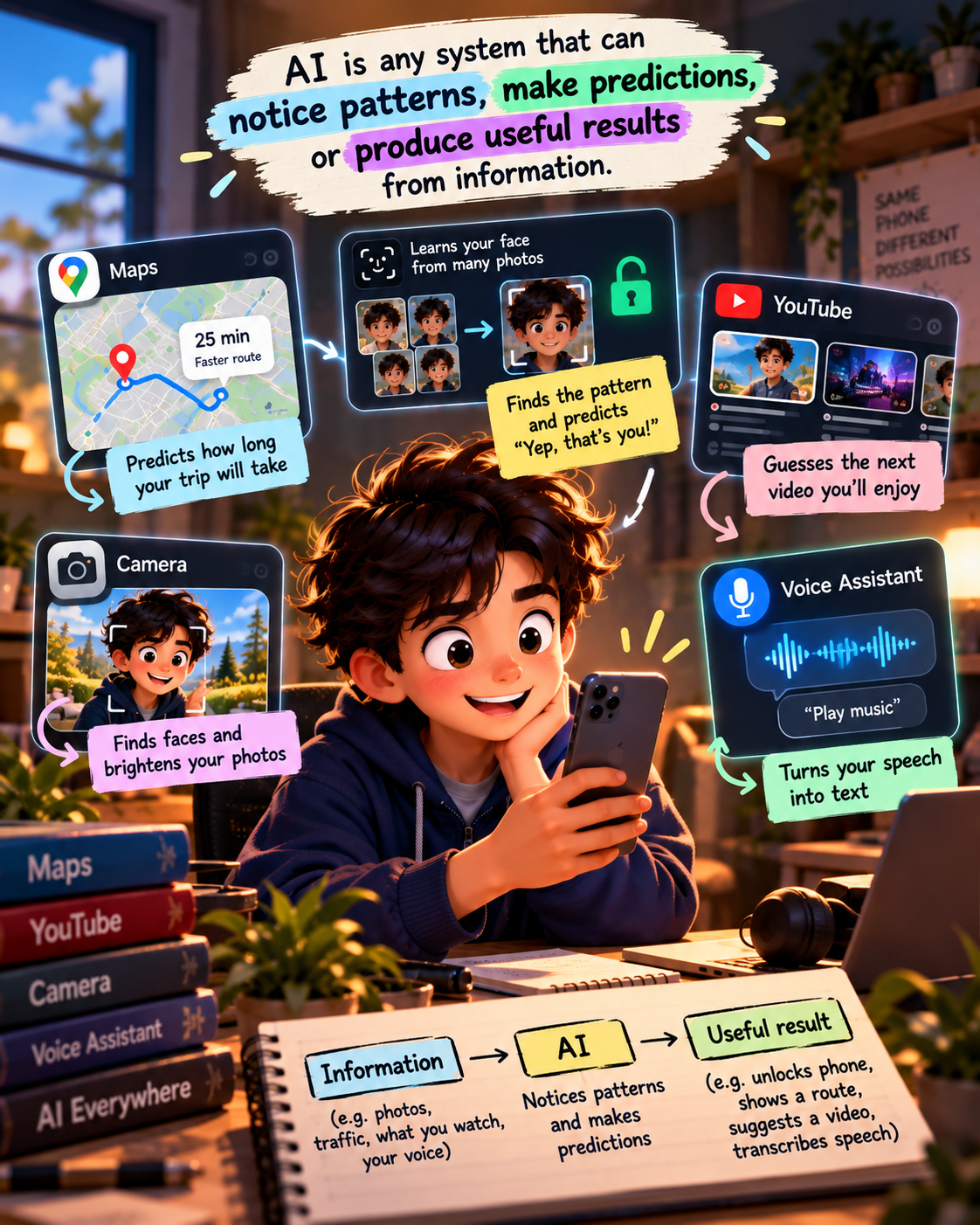
In this course, we focus on AI systems that learn patterns from examples. They can use those patterns to classify, predict or generate an output.
For example, a photo sorter may learn from labelled pictures and guess which new pictures contain cats. A school bell timer can follow a fixed schedule without learning from examples.
Sometimes we need more information to know how a tool works. AI is a wider field; learning from examples is the part we start with.
हिंदी में: यहाँ हम उदाहरणों से patterns सीखने वाला AI समझेंगे। हर उपयोगी computer program AI नहीं होता। Tool का तरीका पता न हो तो और जानकारी माँगें।
| What you did | Information it used | Its prediction |
|---|---|---|
| Opened YouTube | Videos you watched before | "You'll like this next" |
| Checked Maps | Live traffic | "About 25 minutes" |
| Typed a message | The words so far | "Next word: ghar" |
| Took a selfie | The camera image | "A face is right here" |
| Asked a voice assistant | Your voice | "You said: play music" |
Notice the pattern in every row: information → prediction.
Which one is AI making a prediction?
Take-home mission · Come back to this task later. You can continue the lesson now.
Over the next hour, find five things around you that use AI. For each one, jot down:
Hint: look for apps that suggest, recognise, translate or auto-complete.
AI is a very smart guesser, not a mind-reader. It works from information and patterns — so it can be brilliant, and it can also be wrong.
Your friend says, "So the phone thinks exactly like a human brain!" Write 2–3 sentences explaining why that's not quite true.
Clue: does your phone understand your face the way you understand a friend — or does it just match a pattern?
This chapter is free — open this lesson in your portal to save your answers and track progress.